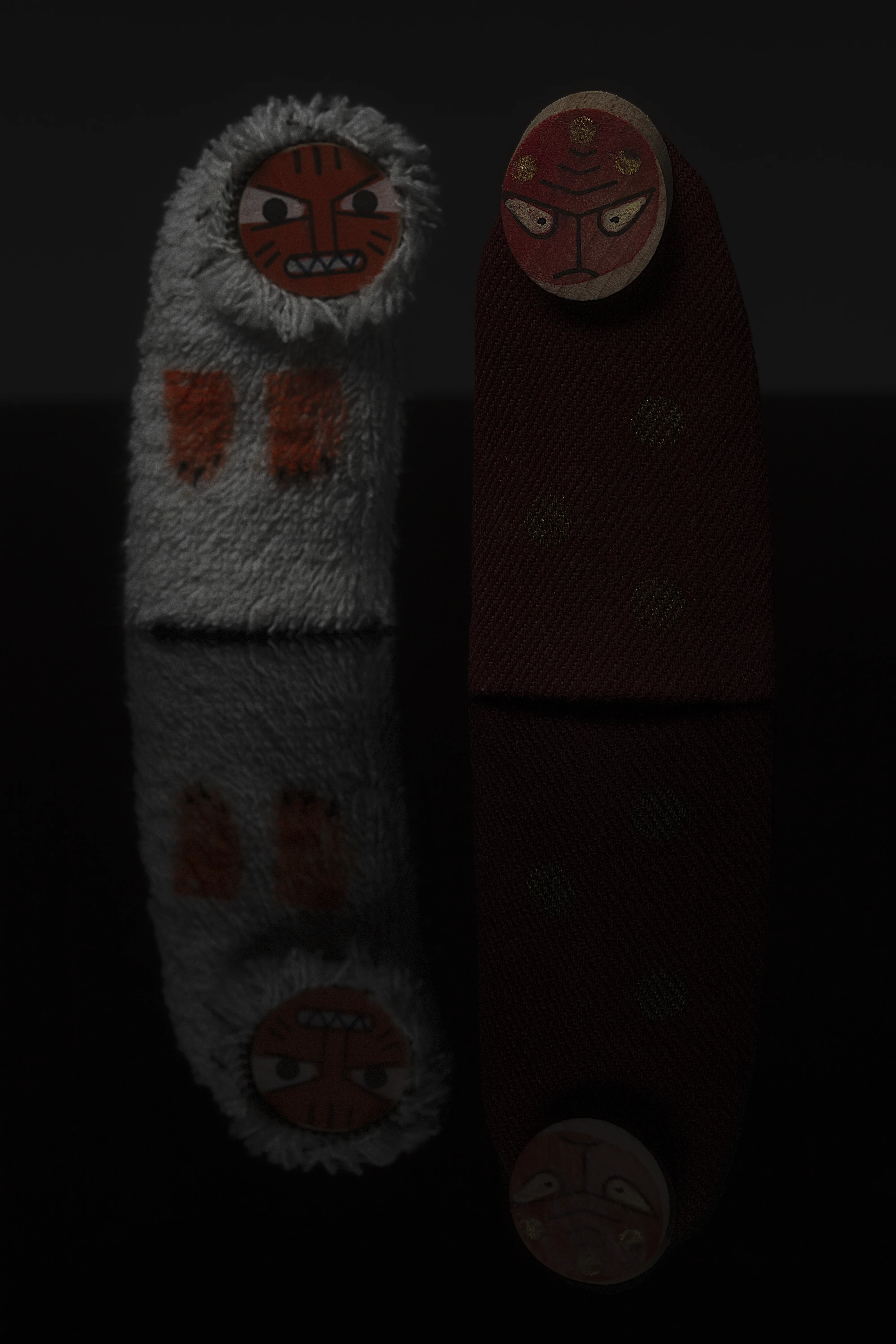
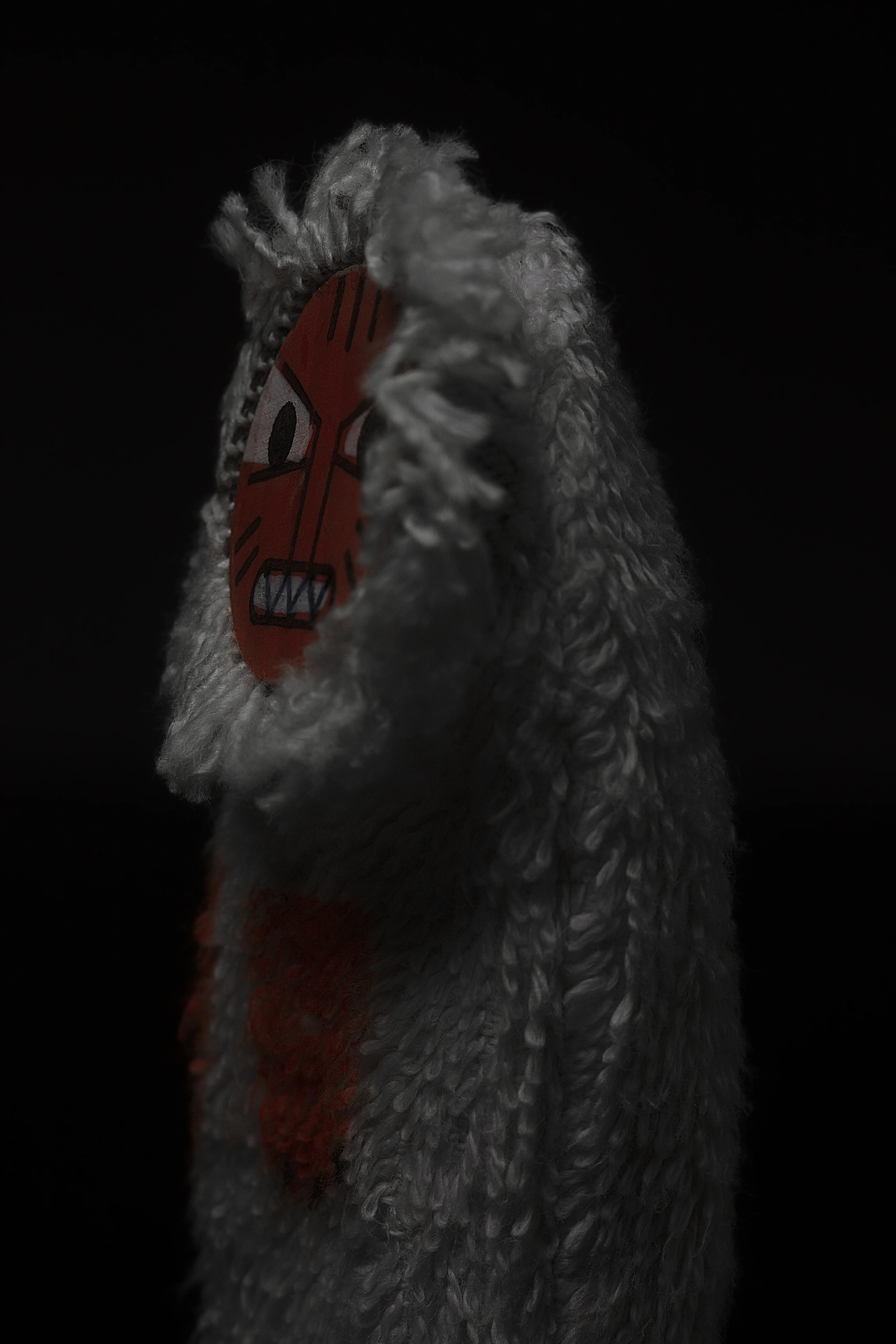
Tal Nori Finger Puppets
The Korean mask play Tal Nori originated in Korea in the 12th century or earlier. Originally performed to honor the gods, it later often addressed social tensions through satire and mockery of renegade Buddhist priests and the nobility. I was captivated by the masks’ powerful emotional expressions and the beauty of these ancient, distinctive rituals. To create figures that could be taken home as souvenirs, I scaled them down while retaining the predominant materials: wood for the masks and fabric for the garments. Keeping the playful nature of Tal Nori in mind, I chose finger puppets rather than dolls. The faces of the five selected figures are hand-stamped, a technique that allows for high repeatability without sacrificing the uniqueness of each piece. Their reduced designs, dominated by lines and geometric forms, draw inspiration from the Swiss typographic and design traditions of the 1950s. The finger puppets and wooden pieces were produced at Marktlücke, a social workshop in Zurich that supports women seeking asylum as they re-enter the workforce. The faces were stamped by Anne Bachmann.
Anne Bachmann
Anne Bachmann’s design career began with an apprenticeship as a radiology nurse at Zurich University Hospital, where making the invisible visible became a lasting fascination. X-ray images soon became an important source of inspiration for her private art and design projects, eventually growing more relevant than their medical purpose. She later trained as an art teacher and taught art, drawing, and handicrafts for several years. During her Industrial Design studies at ZHdK, she acquired the techniques needed to make the invisible tangible. Since 2009, she has committed herself to FREITAG lab. ag and its purpose, “Intelligent Design for a Circular Future,” working as a holistic designer, design strategist, creative director, and member of Brand Guidance. She lives with her family in Zurich.